
Metabolic and cytoskeletal control of neutrophil swarming and cluster formation
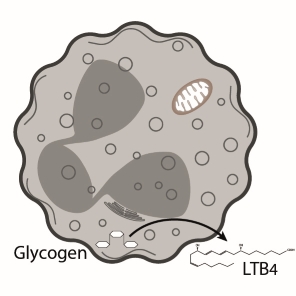
Neutrophil swarming and cluster formation are essential for containing tissue lesions during inflammation and infections. Many individual neutrophils concentrate their combined effector functions around damaged tissue. Swarming results from a coordinated sequence of cellular responses. We revealed glycogenolysis as a metabolic pathway for the release of the swarming mediator leukotriene B4 (LTB4). Thus, the sequential steps of the swarming cascade appear to be under differential metabolic control. Based on this hypothesis, we visualise glycogen deposits in neutrophils to assess metabolic states and investigate the mechanistic interplay between glycogen regulation and LTB4 synthesis. Additionally, we establish setups for the study of cytoskeletal and metabolic adaptation processes in three-dimensional neutrophil clusters. Finally, we determine the influence of cell crowding on the neutrophil phenotype. Our future findings should prove useful for modulating neutrophil swarming and clustering responses on the metabolic level.
Team
Publications
The Broad Spectrum of Myeloid Cell Migration StrategiesVehring, L.; Najder-Nalepa, K.; Stegmeyer, R. I.; Mihlan, M.; Lämmermann, T.
2026 Curr Opin Cell Biol
|
Mast Cell Homeostasis Depends on KIT Ligand from Dermal Fibroblasts and Perivascular Cells in Mouse SkinMartzloff, P.; Testroet, F.; Salatino, A.; Ahmed, A.; Manke, T.; Biggs, L. C.; Rognoni, E.; Bajénoff, M.; Mihlan, M.; Lämmermann, T.
2026 J Invest Dermatol
|
The Arp2/3 Complex Controls the Development of Homeostatic MicrogliaSafaiyan, S.; Frosch, M.; Bickel, T.; Monaco, G.; Dvir, R.; Madry, C.; Bosch, L. F. P.; Kierdorf, K.; Innocenti, M.; Priller, J.; Prinz, M.; Lämmermann, T.
2026 EMBO Rep
|
TSP1/TGF-Β1 Drives Arachidonic Acid Metabolism to Orchestrate Neutrophil SwarmingWidera, L.; Spangenberg, P.; Siemes, D.; Bessler, S.; Bottek, J.; Voss, H.; Novak, A.; Hueser, D.; Richter, M.; Potthoff, A.; Siebels, B.; Moritz, M.; Gocke, A.; Thiebes, S.; Tautges, S.; Chavakis, T.; Jablonska, J.; Lämmermann, T.; Gunzer, M.; Schlüter, H.; Hahn, J.; Grüneboom, A.; Soehnlein, O.; Dreisewerd, K.; Soltwisch, J.; Shevchuk, O.; Engel, D. R.
2025 bioRxiv
|
Early Microglia Progenitors Colonize the Embryonic CNS via Integrin-Mediated Migration from the Pial SurfacePetry, P.; Oschwald, A.; Merkt, S.; Dinh, T.-L. J.; Andrieux, G.; Crisand, C.; Botterer, H.; Nent, E.; Paterson, N.; Havermans, M.; Sankowski, R.; Schilling, O.; Boerries, M.; Amann, L.; Groß, O.; Schlitzer, A.; Prinz, M.; Lämmermann, T.; Kierdorf, K.
2025 Dev Cell
|
Extrasinusoidal Macrophages Are a Distinct Subset of Immunologically Active Dural MacrophagesAmann, L.; Fell, A.; Monaco, G.; Sankowski, R.; Wu, H. Z. Q.; Jordão, M. J. C.; Borst, K.; Fliegauf, M.; Masuda, T.; Ardura-Fabregat, A.; Paterson, N.; Nent, E.; Cook, J.; Staszewski, O.; Mossad, O.; Falk, T.; Louveau, A.; Smirnov, I.; Kipnis, J.; Lämmermann, T.; Prinz, M.
2024 Sci Immunol
|
Extrasinusoidal Macrophages Are a Distinct Subset of Immunologically Active Dural MacrophagesAmann, L.; Fell, A.; Monaco, G.; Sankowski, R.; Wu, H. Z. Q.; Jordão, M. J. C.; Borst, K.; Fliegauf, M.; Masuda, T.; Ardura-Fabregat, A.; Paterson, N.; Nent, E.; Cook, J.; Staszewski, O.; Mossad, O.; Falk, T.; Louveau, A.; Smirnov, I.; Kipnis, J.; Lämmermann, T.; Prinz, M.
2024 Sci Immunol
|
Neutrophil trapping and nexocytosis, mast cell-mediated processes for inflammatory signal relayMihlan, M.; Wissmann, S.; Gavrilov, A.; Kaltenbach, L.; Britz, M.; Franke, K.; Hummel, B.; Imle, A.; Suzuki, R.; Stecher, M.; Glaser, K. M.; Lorentz, A.; Carmeliet, P.; Yokomizo, T.; Hilgendorf, I.; Sawarkar, R.; Diz-Muñoz, A.; Buescher, J. M.; Mittler, G.; Maurer, M.; Krause, K.; Babina, M.; Erpenbeck, L.; Frank, M.; Rambold, A. S.; Lämmermann, T.
2024 Cell
|